
Raw vs graded cards, and what grading does to value
Grading changes what a card is worth. It does not change the card. Understanding why the market pays more for the same cardboard in a slab is the difference between grading profitably and paying fees for nothing.
What grading actually sells
A grading company does two things. It authenticates the card, and it assigns a condition grade on a fixed scale. What collectors are buying in a graded card is the removal of uncertainty.
With a raw card, the buyer is trusting the seller's description and a few photographs. With a graded card, a third party has already made the judgment and sealed it. That certainty is what carries the premium, and it is why the premium is largest on expensive cards, where being wrong about condition costs the most.
The gap between grades is not linear
New collectors often assume grades scale smoothly, that a 9 is worth a bit less than a 10. The market does not work that way.
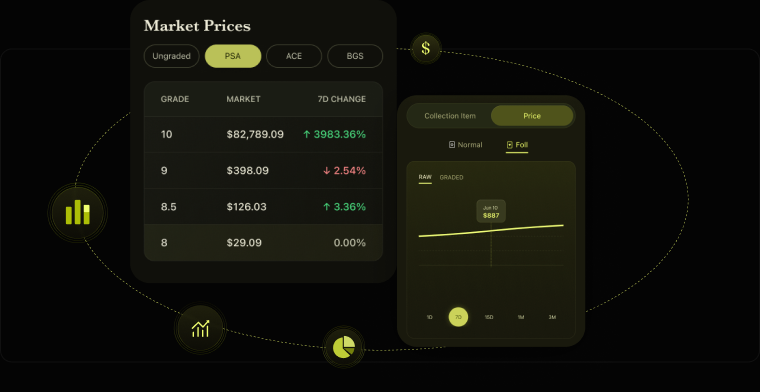
On a card with strong demand, the step from a 9 to a 10 can be several multiples, while the step from a 7 to an 8 is modest. The reason is population. Top grades are scarce relative to demand, and each grade below the top has progressively less competition for it.
The practical consequence: the value of grading depends almost entirely on whether your card lands at the top of the scale. A card that grades 8 when you hoped for 10 will often not recover the submission cost.
When grading is worth it
Grading has a real cost in fees and turnaround time. A rough filter:
- Grade it when the card is valuable, the raw copy looks genuinely clean under proper light, and the premium at the top grade is large enough to clear fees several times over.
- Leave it raw when the card is inexpensive, when the condition is visibly compromised, or when the top-grade premium is thin.
- Be skeptical of your own assessment. Centering is the most common reason a card that looks perfect comes back below the top grade, and it is the easiest thing to talk yourself out of noticing.
Tracking both in one collection
If you collect seriously you will end up holding both raw and graded copies, sometimes of the same card. They need to be tracked as separate positions, because they have separate prices and behave differently.
Card AI records each copy with its own status. A raw card is stored with its condition. A graded card is stored with the grading company and grade, covering PSA, BGS, CGC and SGC. The same card can appear in your collection more than once, as a raw copy and as a PSA 10, each valued on its own market.
To be clear about what the app does and does not do: you record the grade from the slab. Card AI does not predict what a raw card would grade, and no scanner can tell you that reliably from a photograph.