What is my trading card worth?
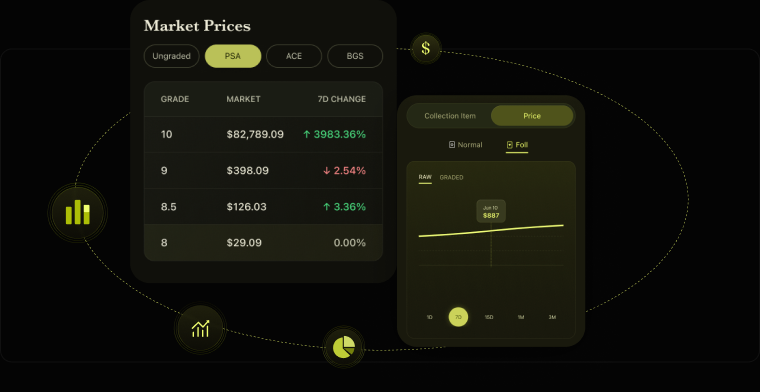
"What is my card worth" is the most common question in collecting, and the honest answer is that a single card usually has several different prices at once. Knowing which one applies to your copy is the whole skill.
The same card has more than one price
Pull up any well-known card and you will find prices that disagree with each other by a wide margin. That is not the market being broken. It is four variables doing their job:
- The printing. Set, card number, edition and variant. A first edition and an unlimited print of the same card are different assets.
- The finish. Holo, reverse holo, foil, borderless or plain. The market prices these separately.
- The condition. A near-mint raw copy and a lightly played one are not interchangeable.
- The grade. A graded card trades in a different market from a raw one.
Any tool that gives you one number for a card name is averaging across all of that, which means it is wrong for your specific copy in a way you cannot see.
Start by identifying the exact printing
Before you can price a card you have to know which card you have. The reliable signals are on the card itself: the set symbol, the collector or card number, the edition marking, and whether the surface is holo or foil.
This is the step people skip, and it is the step that produces most bad valuations. A scanner should narrow the catalog to plausible matches with details such as the set and card number. You still need to review that match and confirm the specific finish, language and condition or slab grade before valuing the copy.
Then decide whether you are pricing raw or graded
Once you know the printing, the next fork is grading.
Raw cards
Raw cards are priced by condition. The market generally works in bands, from near mint down through lightly played and worse, and the spread between the top and bottom band on a valuable card can be large. Be honest about condition. Centering, edge wear and surface scratches all count, and a card you think is near mint often is not.
Graded cards
A graded card carries a grade from a third party such as PSA, BGS, CGC or SGC, and it trades on that grade. The jump between adjacent grades is rarely linear. On a sought-after card the gap between a 9 and a 10 can be several multiples, because the population at the top grade is small.
This is why raw and graded prices should never be blended into one figure. They are answering different questions.
Look at the history, not just today's number
A current price is a snapshot. It cannot tell you whether the card has been climbing for six months or is falling after a reprint announcement, and that trend is usually what you actually want to know.
Before you act on a valuation, look at where the price has been. A card that is worth the same today as it was last year is a different proposition from one that got there by halving.
Checking a card with Card AI
Card AI starts by comparing the photo with its catalog and suggesting likely card records with the set and card number. In Review, you confirm the matching card, finish and language, then choose a raw condition or enter the grade shown on an existing slab. Card AI uses that selection to show the relevant market price and price history.
If you do not have the card in hand, you can search the card database by name, set or card number and reach the same record.
One note on scope: Card AI prices cards by the grade you record from the slab. It does not predict what a raw card would grade if you submitted it. Anyone offering that number is estimating, and the estimate is not what the market pays.